
Key takeaways
- ZLD means no liquid effluent leaves the site — water is recovered for reuse and the dissolved salts are converted into a solid residue.
- Reverse osmosis on its own is not ZLD: it produces a concentrated reject stream that still has to go somewhere. Evaporation is what closes the loop.
- A ZLD plant is a chain — pre-treatment, membranes, evaporation and drying — and the performance of each stage depends on the one before it.
- MEE, MVR and electrically heated evaporators suit different situations; the choice depends on reject volume, scaling and fouling behaviour, and the energy you have available.
- Plan for the solid residue as well: salt handling and disposal is a real operating cost.
Zero Liquid Discharge (ZLD) is a wastewater management approach in which no liquid effluent leaves the plant boundary. Water is recovered and reused in the process, and the dissolved salts and impurities are turned into a solid residue that is disposed of separately. Industries adopt it because of regulatory requirements, restrictions on discharge in a location, water scarcity, or simply because the cost of fresh water and disposal makes reuse the better business decision.
This guide explains how a ZLD plant is put together, why reverse osmosis alone does not achieve it, and how to think about choosing between evaporation technologies.
Why RO alone is not ZLD
A reverse osmosis (RO) plant separates treated wastewater into two streams: clean permeate that can be reused, and a smaller stream of concentrated reject carrying the salts that were removed. Depending on the feed and the membranes, the reject volume can still be a meaningful fraction of the total flow, and its dissolved solids are now concentrated. An RO-only system therefore reduces the discharge but does not eliminate it. Where a site must reach zero liquid discharge, the reject has to be treated further, and this is the job of evaporation.
The typical ZLD process train
Although every plant is designed around its own effluent, most ZLD systems follow the same sequence.
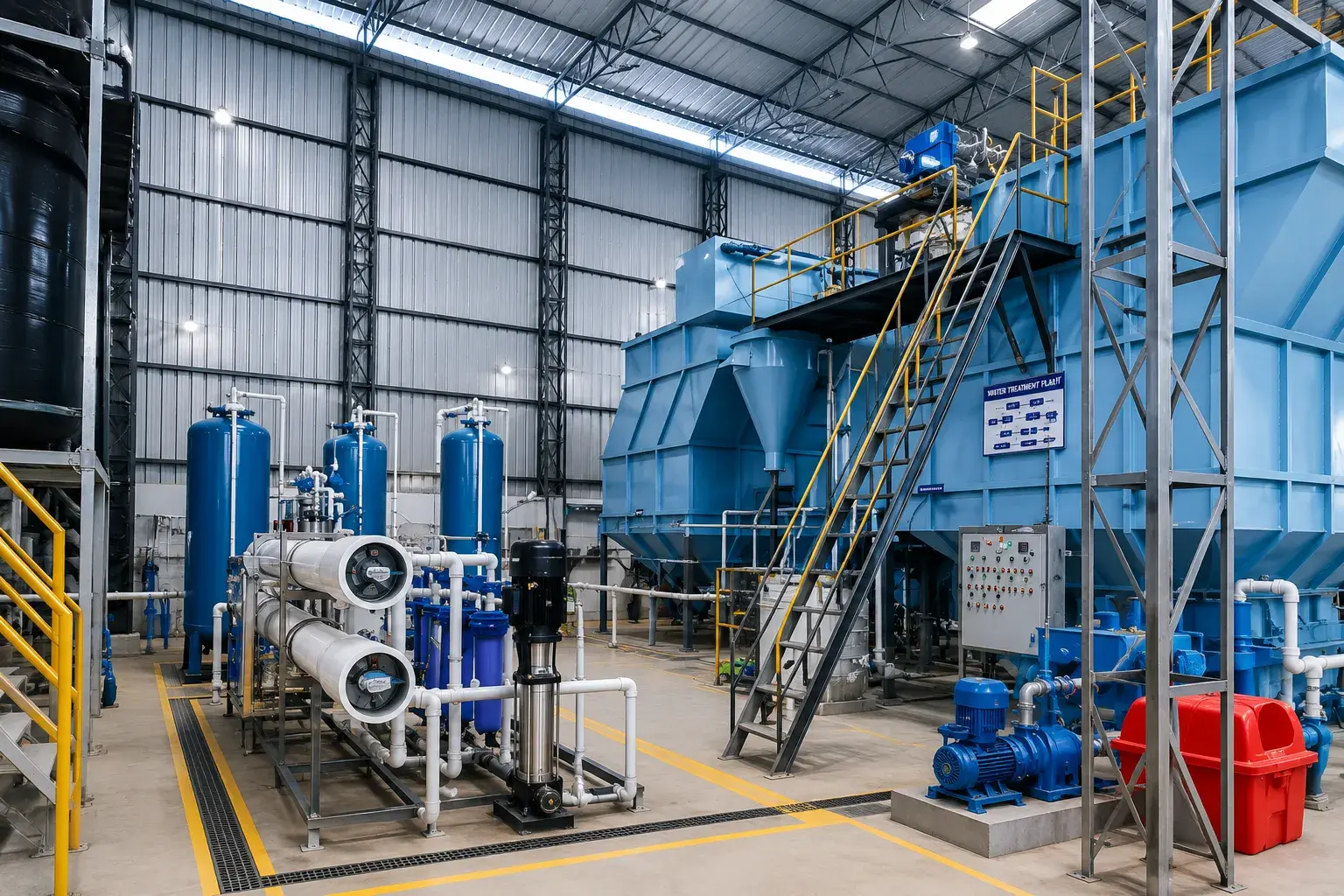
- Effluent treatment (ETP). Physico-chemical and biological treatment remove suspended solids, organics and other pollutants that would otherwise foul membranes and evaporators. See our ETP guide.
- Tertiary and membrane pre-treatment. Filtration, softening and ultrafiltration protect the RO membranes from scaling and fouling.
- Reverse osmosis. Recovers the bulk of the water for reuse and concentrates the salts into the reject stream.
- Evaporation. A multiple effect evaporator (MEE) or MVR plant boils off water from the reject and returns it as clean condensate, further concentrating the brine.
- Drying. An agitated thin-film dryer (ATFD) takes the concentrated brine down to a dry or semi-dry solid.
- Solid handling. The residue is collected, stored and sent for authorised disposal or recovery, depending on its composition and your authorisation.
Our Zero Liquid Discharge plants are engineered as one connected train so that the ETP, membranes, evaporators and dryer are designed together rather than added piece by piece.
Choosing an evaporation technology
| Option | How it works | Suits | Watch-outs |
|---|---|---|---|
| MEE — Multiple Effect Evaporator | Steam heats the first effect; the vapour produced drives the next effect, so the same energy evaporates water several times | Sites with a boiler or cheap steam and moderate-to-large reject flows | Needs a steam source; scaling and fouling must be designed for; more equipment to maintain |
| MVR — Mechanical Vapour Recompression | A compressor recompresses the vapour so it can heat the evaporator again, cutting steam needs | Sites where electricity is available and steam is costly or unavailable | Compressor cost and maintenance; sensitive to feed that scales or foams heavily |
| Electric evaporation plant | Electrically heated evaporator with no dependence on a boiler | Small reject volumes and sites without steam | Higher energy use per litre evaporated, so best suited to smaller flows |
| ATFD — Agitated Thin-Film Dryer | Spreads concentrated brine as a thin film on a heated surface to finish drying it | The final step after MEE or MVR, to produce a solid residue | Not a stand-alone answer for large liquid volumes |
The design questions that decide the answer
- How much reject will you produce, and how salty is it? Volume and concentration set the size and type of evaporator.
- What will scale or foul the equipment? Calcium, magnesium, silica, sulphate and organic matter each behave differently. Characterise them before choosing.
- How much organic load (COD) is left in the reject? It affects boiling behaviour, condensate quality and how much of the water can be reused.
- What energy is available and what does it cost? Steam-rich sites lean toward MEE; power-rich sites often favour MVR.
- What quality of condensate do you need? Condensate is often reused in cooling towers or boilers and may need polishing.
- How will you handle the salt? Mixed salts can be classified as hazardous waste. Know where they will go before you commission.
- How reliable does it need to be? A ZLD plant is a chain — build in standby capacity and maintenance access for the critical items.
Common ZLD mistakes
- Cutting corners on pre-treatment. Membranes and evaporators are the expensive parts; protect them with proper upstream treatment.
- Designing the evaporator for average, not worst-case, reject chemistry. Variability in production changes the feed.
- Ignoring the residue. The plant is not finished until the solid has a defined, authorised destination.
- No provision for cleaning. Scaling is inevitable; make cleaning easy and scheduled.
- Treating ZLD as a purchase rather than a process. Operator skill, monitoring and maintenance decide long-term performance — consider an operation and maintenance contract.
How Bharti Enviro helps
Bharti Enviro Services Pvt. Ltd. designs and delivers wastewater treatment systems from ETPs to full ZLD trains. We begin with effluent characterisation in our laboratory, evaluate options such as RO, MEE, MVR and ATFD for your reject, and design a system around your energy availability, discharge conditions and reuse goals. Talk to us about a ZLD assessment for your plant.
Frequently asked questions
What is Zero Liquid Discharge (ZLD)?
ZLD is a wastewater management approach in which no liquid effluent leaves the plant. Water is recovered and reused, and the dissolved solids are converted into a solid residue for separate disposal.
Is RO enough for Zero Liquid Discharge?
No. RO recovers clean water but leaves a concentrated reject stream. To reach ZLD, that reject is further treated by evaporation and drying so that only a solid residue remains.
What is the difference between MEE and MVR?
Both evaporate water from a concentrated stream. An MEE uses steam and reuses the vapour across several effects, while an MVR uses a compressor to recompress vapour so it can supply the heat, reducing steam use. The better choice depends on steam and power availability, reject volume and scaling behaviour.
What is an ATFD used for in a ZLD plant?
An agitated thin-film dryer is used as the final stage. It takes the concentrated brine from the evaporator and dries it to a solid or semi-solid residue.
What happens to the solid residue from a ZLD plant?
The residue, usually a mixture of salts and other solids, must be stored and disposed of as required by your authorisation. Depending on its composition it may be classified as hazardous waste, so plan its disposal route early.
When does an industry need ZLD?
When the regulator, the industrial estate or the location does not permit liquid discharge, and in many water-scarce areas where reuse makes economic sense. Your consent conditions will state the requirement.
Can a small plant use ZLD?
Yes. Smaller flows are often handled with an electrically heated evaporator or a compact evaporator-and-dryer arrangement. The design depends on the volume of reject and the energy available.